Netanyahu turns his deterrence dilemma into a nuclear gamble
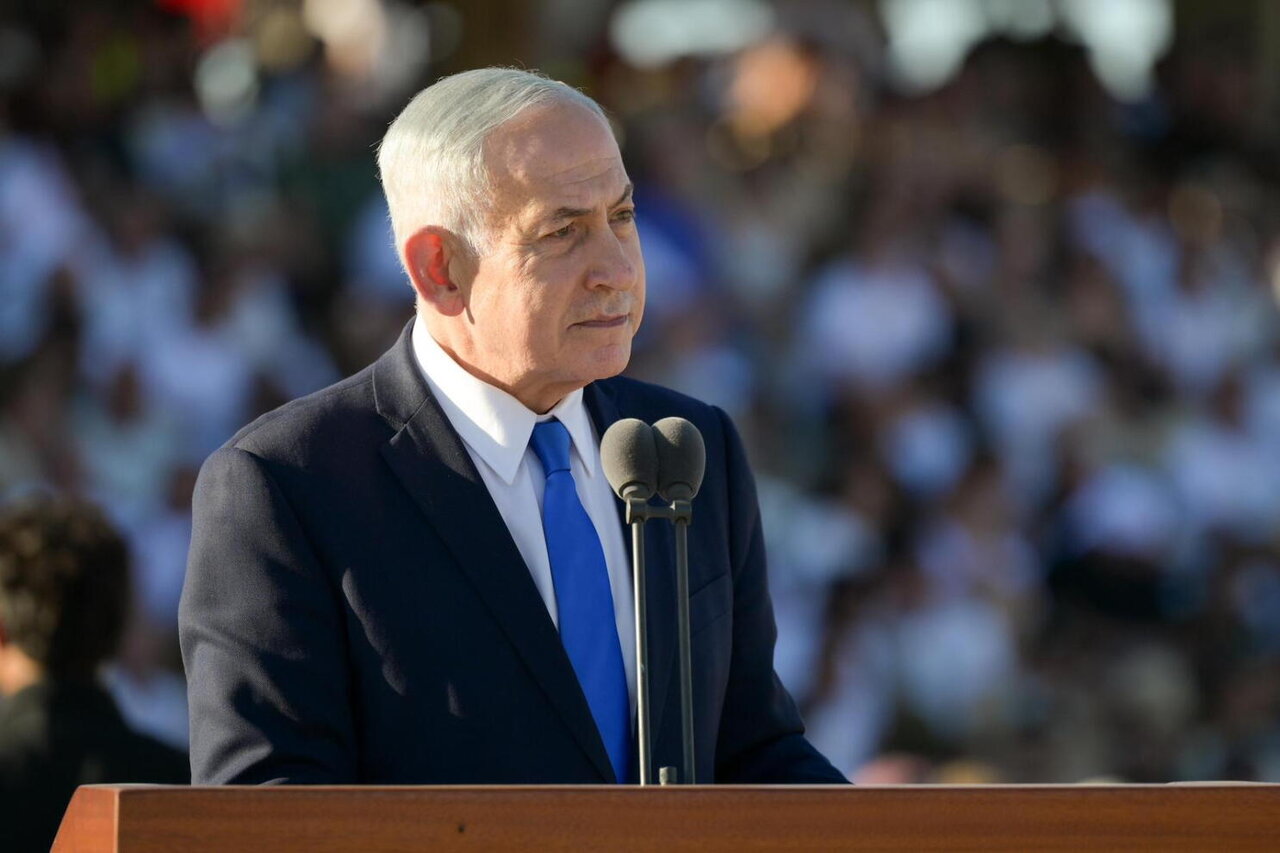
TEHRAN – Benjamin Netanyahu’s use of Dimona as a platform to threaten Iran exposes the failure of decisive victory and the erosion of Zionist deterrence.
It also exposes the international community’s hypocrisy in shielding Israel’s nuclear warhead arsenal while allowing the regime’s aggression to continue without punitive measures, threatening the security of both the region and the wider world.
Dimona was the true speaker, while Netanyahu served as the voice of the project seeking to deliver its message from there. The city was more than just the setting for a speech, and his visit to the Atomic Energy Commission site was far more than a symbolic stop.
The location itself was part of the threat, and perhaps more dangerous than the words themselves.
From there, Netanyahu warned Iran’s leaders not to “bet on calm” if they attacked his genocidal regime, and not to expect a repeat of what happened in previous rounds, because the next response, according to him, would be “very different and far more powerful.” He then declared that the days when the regime was attacked without responding with a “double strike” were over.
Yet the speech, when stripped of the illusion of strength and intimidation, reveals more than its speaker intended to conceal. It came from Dimona, the city that houses the nuclear reactor not subject to comprehensive international oversight, and it was directed at a country that has not been proven to seek nuclear weapons.
It came after wars that Netanyahu claimed had destroyed Iran’s capabilities and changed the region’s balance of power, only for him now to prepare for “all scenarios” and warn of a new Iranian attack.
However, the danger is no longer confined to Iran and the Axis of Resistance. What the Israeli regime has done, from Gaza and the West Bank to Lebanon, Syria, and Iran, reveals a project that views unchecked force as a permanent means of redrawing the region and subjugating its peoples.
As a result, Netanyahu and other Zionist fascists have transformed from a threat against a particular state or axis into a direct threat to regional security and international peace.
The first contradiction lies in Netanyahu’s choice of the symbol of the Israeli nuclear project to threaten Iran in the name of security and preventing nuclear proliferation.
Israel is the only party in the region that has not joined the Nuclear Non-Proliferation Treaty (NPT), does not place its facilities under comprehensive supervision by the International Atomic Energy Agency (IAEA), and maintains a policy of “nuclear ambiguity” even though that ambiguity now exists only in diplomatic language that has become a cover for complicity.
The Stockholm International Peace Research Institute estimates that the Zionist regime’s arsenal contains around 90 nuclear warheads and that it continues to modernize its capabilities and delivery systems.
By contrast, Iran, regardless of disagreements over enrichment levels and the scope of its cooperation with the IAEA, remains a party to the NPT, and no competent international body has announced that it is seeking to develop a nuclear bomb.
Nevertheless, Iran’s program is treated as the greatest nuclear threat, while Israel’s nuclear-armed arsenal enjoys political immunity almost equal to its military’s war crimes.
This is a fully developed form of international nuclear hypocrisy: those who abide by treaties are surrounded and pressured, while those who stand outside are protected. Iranian nuclear facilities are bombed in the name of preventing danger. At the same time, the Dimona reactor is allowed to operate in the dark, its arsenal granted immunity from oversight and accountability and even the ability to threaten the region.
The issue is not about preventing proliferation; it is about monopolizing power. The Zionist regime does not want a “Middle East” free of nuclear weapons. It wants a “Middle East” in which it alone possesses such weapons, while other states are not even allowed to use nuclear technology for civilian purposes.
Dimona was not a backdrop for Netanyahu’s speech; it was a signal of what the regime possesses while refusing to officially acknowledge possessing it. Yet Netanyahu, by bringing the reactor into the arena of threats, weakened the very policy of ambiguity that has protected the Zionist nuclear project for decades. Ambiguity loses its meaning when a nuclear site becomes a platform for sending messages of war.
The second contradiction lies in the fact that Netanyahu’s threat, presented as a display of strength, carries within it an admission of failure to achieve a decisive victory.
If the American-Zionist strikes destroyed Iran’s nuclear program and crippled its missile capabilities, then why does he expect a new Iranian attack? Why does he announce readiness for all scenarios? And why does he need to promise that the next response will be stronger than the previous one?
The side that has won a war does not stand before its audience warning them of another war, and the side that has fully restored its deterrence does not need to exaggerate what it will do if that deterrence is tested again.
The rounds of confrontation have proven that military and technological superiority does not guarantee the ability to achieve a decisive victory.
Despite the strikes and losses it suffered, Iran has been able to preserve its will to retaliate and retain a significant portion of the tools required to do so, while bringing the war into Israel’s territory and against American bases in the region.
Therefore, Netanyahu’s threats do not negate Iran’s ability to respond; they confirm it, because they are based on the assumption that Tehran is still capable of inflicting damage that requires a response “far more powerful.”
Netanyahu is also attempting to reverse the sequence of aggression and retaliation. The regime that participated in launching the illegal war against Iran, targeting its territory, facilities, scientists, and leaders, now presents itself as the threatened party and demands that Tehran refrain from responding; its response will be considered a new act of aggression requiring a “double strike.”
In this way, the regime grants itself the freedom to start and resume wars, while turning the other side’s self-defense into a pretext for expanding aggression.
However, the threat extends beyond the battlefield to the negotiating table. The American-Iranian memorandum of understanding, signed on June 17, established an initial 60-day negotiation process addressing the cessation of military operations, freedom of navigation in the Strait of Hormuz, Iran’s nuclear program, and sanctions. Israel is not a direct party to these negotiations, but it seeks to possess veto power over their outcomes.
In essence, Netanyahu is addressing Washington as much as he is addressing Tehran. His message is that any American-Iranian understanding that does not meet Zionist conditions will not prevent the regime from returning to war.
He wants to raise the ceiling of American demands and prevent an agreement that recognizes Iran’s rights, preserves any missile or deterrence capabilities, or limits Israel’s freedom to launch attacks whenever it chooses.
Netanyahu and his terrorist regime fear not so much the alleged Iranian bomb as they fear the emergence of a regional balance that would put an end to the regime’s monopoly over power and its control over decisions of war.
Israeli decision makers want the region to remain on the edge of ignition, negotiations to take place under a bombing campaign, and Washington to remain captive to the Zionist narrative and its conditions.
The most dangerous thing Netanyahu has done is transform Dimona from a symbol of nuclear ambiguity into an open element in the discourse of war.
Leave a Comment